

DURABILITY ENGINEERING
Our team provides durability engineering services for concrete structures in new construction and existing assets. Work focuses on exposure conditions, deterioration mechanisms, constructability risk, and service life performance so that decision makers can reduce lifecycle cost and avoid preventable repairs.




WHAT IS DURABILITY ENGINEERING?
Concrete durability challenges are rarely caused by a single factor. Performance depends on exposure severity, mixture and materials performance, detailing, curing, and construction execution. Durability engineering provides a structured approach to identify risk early, confirm deterioration mechanisms in existing structures, and develop practical actions that maintain service life.
Common durability concerns include chloride driven corrosion, carbonation, freeze-thaw distress, sulfate attack, alkali-silica reaction (ASR), delayed ettringite formation (DEF), chemical exposure, abrasion, and cracking driven durability loss.
DURABILITY PLANNING
Durability planning supports projects before construction. The goal is to align durability objectives with exposure conditions, performance requirements, construction constraints, and maintenance expectations to achieve service life targets. DE support may include:
-
Definition of durability objectives, target service life, and maintenance intent for critical elements
-
Exposure condition evaluation and durability risk matrix development
-
Performance criteria recommendations for concrete and reinforcement protection
-
Thermal and cracking risk review for placements where early age temperature or restraint can drive distress
-
Specification language and bid stage durability planning to reduce nonconformance risk
-
Construction quality approach recommendations tied to durability critical activities
-
Maintenance planning inputs including inspection intervals, monitoring triggers, and repairability considerations
Typical applications include marine and coastal infrastructure, industrial facilities, water and wastewater structures, transportation structures, and energy facilities where aggressive exposure conditions drive durability risk.


DURABILITY ASSESSMENT
Durability assessment supports teams during design and construction when durability risk needs to be documented, tracked, or corrected. DE performs durability assessments when new materials are being introduced, or when nonconformances require an engineering based durability impact evaluation. DE support may include:
-
Review of drawings, specifications, mixture submittals, and construction records
-
Durability design report development that identifies critical elements, durability risks, and durability design solutions
-
Evaluation of testing results and quality control records
-
Troubleshooting of construction driven cracking or early distress mechanisms
-
Recommendations for corrective actions, acceptance criteria, monitoring, or targeted additional testing
DURABILITY INTERVENTION
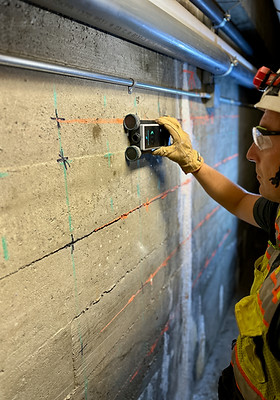
Durability intervention supports existing structures when distress, corrosion, or unusual deterioration indicates a durability mechanism may be active. Work typically combines field assessment, nondestructive testing (NDT), selective sampling, and laboratory analysis to confirm cause, quantify extent, and support a practical path forward. DE support may include:
-
Field inspection and condition assessment
-
Nondestructive testing and selective destructive testing to quantify extent
-
Laboratory testing and petrographic evaluation to confirm deterioration mechanisms
-
Service life evaluation and scenario based planning for repair timing and scope
-
Repair strategy development and repair design coordination
-
Monitoring plan development when deterioration mechanisms are progressive
